
Skip to content
  • Free written estimates
  • Local crews
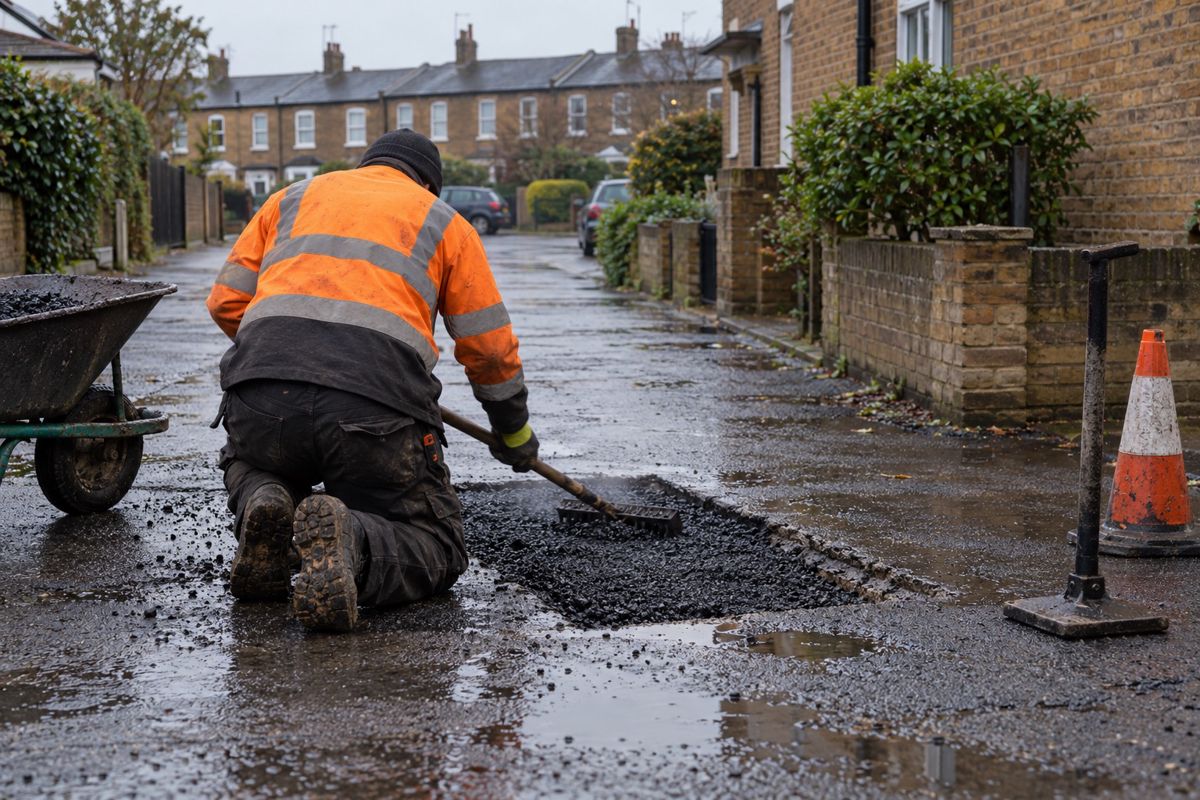
Worker patching a cut-out pothole in a tarmac road with hot material

Pothole repair in London

Pothole repair and tarmac patching in London

Potholes in drives, yards and private roads cut out square and patched properly, not just filled and left.

  • Cut out, cleaned and compacted
  • Drives, yards and private roads
  • Honest advice on patch or resurface

Step 1 of 3

What do you need?

What causes potholes in London?

A pothole starts with a crack. Rain gets in, softens the base underneath and, when frost comes, freezes and widens the gap. London winters are milder than much of the UK, but frost and heavy rain still do the damage, and traffic then breaks up the weakened surface.

Common causes on private sites include:

  • cracks that were never filled, so water kept getting in
  • clay that moves with wet and dry spells and drags the surface with it
  • tree roots pushing up edges and opening cracks
  • heavy vehicles on a drive or yard built for cars
  • utility trenches that were refilled badly, leaving a sunken line

Knowing the cause matters, because a patch put over a moving base will fail again. We look at why the hole appeared before we talk about the repair.

Whose pothole is it?

It depends on where it is. Potholes in a public road or pavement are normally the responsibility of the highway authority, which is your borough council, or Transport for London on its main roads. You can usually report them on your council website or through a service such as FixMyStreet. We do not repair public roads.

Private drives, car parks, yards and access roads are usually the responsibility of the owner. Some roads on housing estates are not adopted by the council, and the people who own the frontages may be responsible for them, so check the position before you pay for work.

For a private surface that is only damaged in places, patching is often the cheapest fix. If the damage is widespread, see our page on commercial paving or on tarmac driveway paving.

How is a pothole repaired properly?

A lasting repair is more than tipping material into a hole. The steps are:

  1. mark a square or rectangular area around the damage, slightly beyond the broken edge
  2. cut out the broken surface and remove loose material and water
  3. firm up the base, or replace it where it has gone soft
  4. paint the sides with a bonding coat so the new tarmac sticks
  5. fill with tarmac in layers, compacting each one
  6. seal the joint around the edge so water cannot creep back in

Quick fills with cold-lay material are a short-term measure and are sometimes used where the area has to reopen quickly. A hot or properly compacted patch lasts longer. We tell you which is suitable for your damage, and what to expect from it.

We do not publish prices, because a small hole and a failed section are very different jobs. The main factors are:

  • the number and size of the damaged areas
  • the depth, and whether the base has also failed
  • access, and whether a small plant or hand tools are needed
  • whether the area has to stay open, or can be closed off
  • how many repairs are grouped into a single visit

You receive a written quote after we have seen the damage. Where several potholes are close together, fixing them at once is often better value than returning for each one, and we say if a larger resurface would make more sense.

How long does it take, and when should I call?

A single pothole patch on a drive can be done in a few hours, and a few patches across a yard may take a day. The area has to be dry when the tarmac goes down, so rain can delay the work.

On the day, we cut out the damage, patch it and compact it. We tell you how long to keep vehicles off the patch, and it is sensible to avoid parking on fresh repairs for as long as we advise. A light colour difference between old and new tarmac is normal at first and fades as the patch weathers.

Call us when a hole has appeared, when edges are crumbling or when you keep topping up the same spot. For protection of the rest of the surface, see sealing and crack filling, or read how it all works on the home page.

What you can expect

1

Free written estimates

2

Local crews

3

Clear timelines

4

Site cleanup included

Questions about paving in London

Can a pothole be repaired in the winter?

Often, yes, but it depends on the weather. Cold-lay material can be used in cold or damp conditions, but it is best seen as a short-term fix. A hot patch lasts longer but needs a drier day. If a hole is dangerous, a temporary repair may be sensible now, with a lasting repair planned for better weather. We explain the choices for your site.

Why does my pothole keep coming back?

Usually because the cause was never fixed. If the base is soft, the ground is moving or water is getting in from a crack nearby, a quick fill will not last. A proper repair cuts out the damage, firms the base and seals the edges. If the same spot keeps failing, it may need a larger patch or a resurface, and we tell you so.

Is a patch strong enough for vans and lorries?

It depends on what is below it. A patch is only as strong as the base, so where heavier vehicles run, the repair has to go deeper and be compacted well. If a drive or yard was built for cars and is now taking vans, repeated patching may not be enough. We look at the loads on your site and say what is sensible.

Will the patch match the rest of the surface?

Not at first. New tarmac is darker and smoother than an old, weathered surface, so a patch shows for a while. The difference fades with traffic and weather. If appearance matters, such as at the front of a house or a business, resurfacing or sealing the whole area gives an even finish. We can describe the options on site.

Can you fix a pothole in a council road outside my property?

No. Public roads and pavements are looked after by the highway authority, which is your borough council or Transport for London on main roads. Report the hole on your council website or through a reporting service. We work on private surfaces such as drives, yards, car parks and private access roads, so call us for those.

Step 1 of 3

What do you need?

Ready when you are Call now or request a quote online. Call for a free estimate Get my free paving quote 020 7946 0921

How it works

  1. Tell us about the surface

    Size, condition and goals.

  2. Site visit and quote

    We measure and price it in writing.

  3. Prep and paving

    Base, drainage and surface done in the right order.

Takes about 30 seconds. Get my free paving quote