
Skip to content
  • Free written estimates
  • Local crews
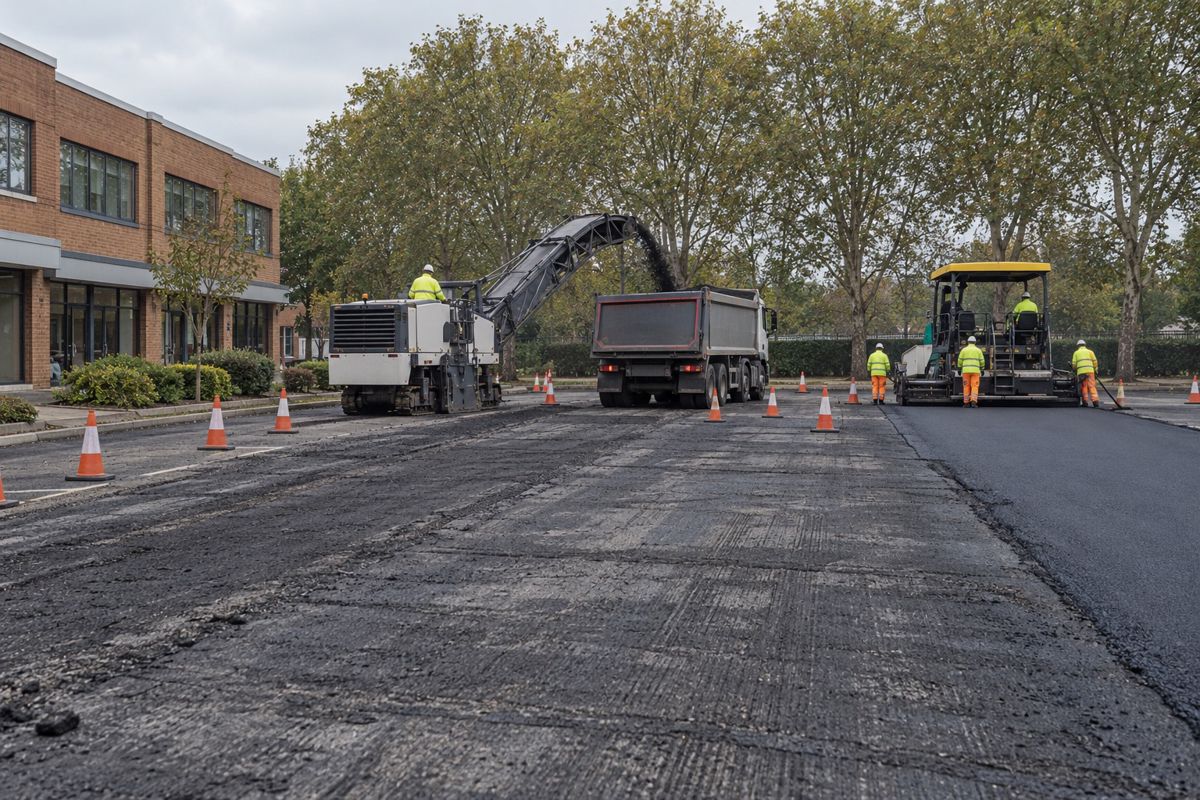
Resurfacing a large commercial car park with a paving machine in London

Commercial paving in London

Commercial paving in London for car parks and yards

Resurfacing and new surfaces for private car parks, yards and access roads. We plan the work around how your site is used.

  • Planing and resurfacing
  • Phased work for busy sites
  • Written quote after a site visit

Step 1 of 3

What do you need?

What does commercial paving cover?

Commercial paving means the hard surfaces around a business, school, church, care home or housing estate. That includes customer and staff car parks, delivery yards, access roads, loading areas and pedestrian routes. These surfaces take far more weight and traffic than a domestic drive, so the build underneath matters.

The work usually falls into one of three types:

  • New surfacing where there is none, or where the area is being extended.
  • Planing and resurfacing, where the worn top layer is machined off and replaced, known in some places as mill and overlay.
  • Reconstruction, where the surface and the base below it have failed and need rebuilding.

We look at the site first and tell you which of the three fits, rather than assuming the biggest job.

Should I resurface the car park or replace it?

The surface tells you a lot. If the top layer is worn, faded or has a few cracks but the ground below is firm, planing and resurfacing is often the sensible route. It costs less than a full rebuild and brings the car park back to a smooth, level finish.

Reconstruction is more likely when you see:

  • a crazed pattern of cracks, like crocodile skin, across wheel tracks
  • deep ruts where lorries or vans turn
  • soft, spongy areas that move under foot
  • standing water that never clears after rain

These point to a base that has failed, and a new surface laid over it will fail again. A short list of patches may be all that some areas need, so see our page on pothole repair and patching if the damage is limited.

What London site conditions affect a commercial paving job?

London sites are often tight. A lorry may have only one gate, a car park may sit behind a row of shops, or neighbours may be a few metres from the work. We talk through these things on the visit, because they shape the plan.

  • Keeping the business open. Many car parks can be done in phases, so part of the area stays in use. We talk through phasing with you before work starts.
  • Neighbours and noise. Some boroughs and landlords set working hours and noise limits near homes.
  • Drainage. Gullies, drain covers and falls need to line up with the new surface. New or enlarged hard areas can also bring drainage and planning questions, so check with your borough.
  • Ownership. A private car park or yard is usually the responsibility of the owner or managing agent, not the council.

We give no prices here because no two sites match. The main factors are:

  • the area and the depth of work, from a light resurface to full reconstruction
  • how much old material is machined or dug out and removed
  • how long the site can be closed, and whether the job is split into phases
  • drainage work, kerbs, ironwork and any repairs to the base
  • access for machines, tipper lorries and delivery trucks

After the visit you receive a written quote that sets out what is included. If you are comparing several quotes, check that they all cover the same depth of work and the same preparation.

How long does it take, and what happens on the day?

The time depends on the area and the type of work. A small car park resurface can take a day or two, and a larger site can take longer, especially when it is done in phases. Rain delays laying, so weather is part of any plan.

On the day, expect cones and barriers, a planing machine, a paver and rollers, and tipper lorries coming and going. We agree the layout of the phases and where staff and visitors can park. After surfacing, the bays need marking, so it is worth planning car park line marking straight afterwards. If the surface is sound but ageing, sealing and crack filling may delay the need for a full resurface.

Call us when your car park shows sunken areas, widening cracks or standing water, or when you are planning an extension. You can also start from the home page to see how a job works.

Free written estimates
Local crews
Clear timelines
Site cleanup included

Questions about paving in London

Can you resurface a car park without closing all of it?

Often, yes. Many car parks can be done in sections, so part of the site stays open while another part is surfaced. It depends on the layout, the number of entrances and how many spaces you need to keep. We look at this on the site visit and talk through a phasing plan with you before any work starts.

What is planing and resurfacing?

A planing machine removes the worn top layer of tarmac, usually to a set depth, so that the level of the surface stays the same around kerbs and drain covers. A new layer is then laid and rolled. It is a cost-effective way to renew a car park whose base is still sound. Some people call it mill and overlay.

How do I know if my car park needs full reconstruction?

Look for a crazed pattern of cracks across wheel tracks, deep ruts, soft spots and water that sits for days after rain. Those signs mean the base has weakened, and a thin new layer will not last. A surface that is only worn or lightly cracked can often be planed and resurfaced instead. We check the condition on site and explain what we find.

Who is responsible for the surface of a private car park?

Usually the owner of the site, or whoever manages it under a lease or agreement. The council looks after public roads, not private car parks and yards. A badly worn surface can cause trips and vehicle damage, so owners often check their lease and speak to their insurer about maintenance duties. We can describe the condition of the surface in writing.

Do I need planning permission to resurface a car park?

Renewing an existing surface like for like generally does not, but new or enlarged hard areas, changes to drainage or work on a protected site can bring in planning questions. Rules vary by borough, and landlords may have their own consent rules too. Check with your borough council and your landlord or managing agent before work begins.

Step 1 of 3

What do you need?

Ready when you are Call now or request a quote online. Call for a free estimate Get my free paving quote 020 7946 0921

How it works

1

Tell us about the surface

Size, condition and goals.

2

Site visit and quote

We measure and price it in writing.

3

Prep and paving

Base, drainage and surface done in the right order.

Takes about 30 seconds. Get my free paving quote